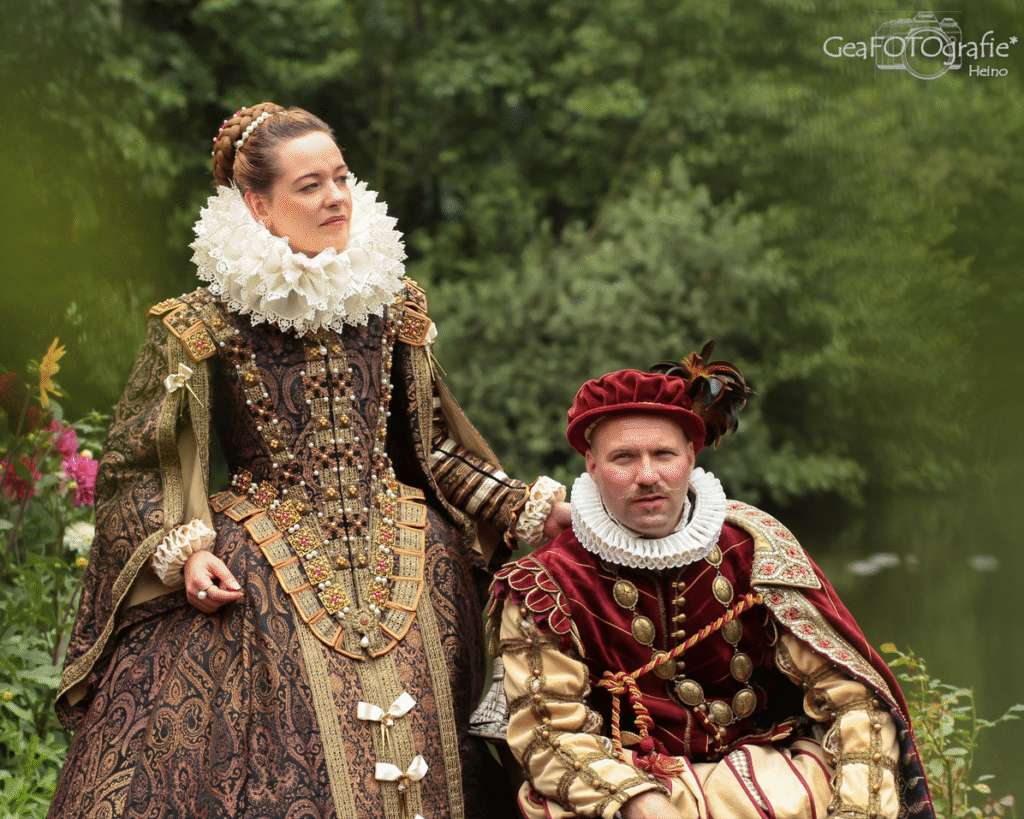
If you’re passionate about historical garments, you’ve likely already come across pictures of the incredible costumes by Walking Through History. The duo behind this project is Angela Mombers and her husband, Jasper de Hoog, from the Netherlands.
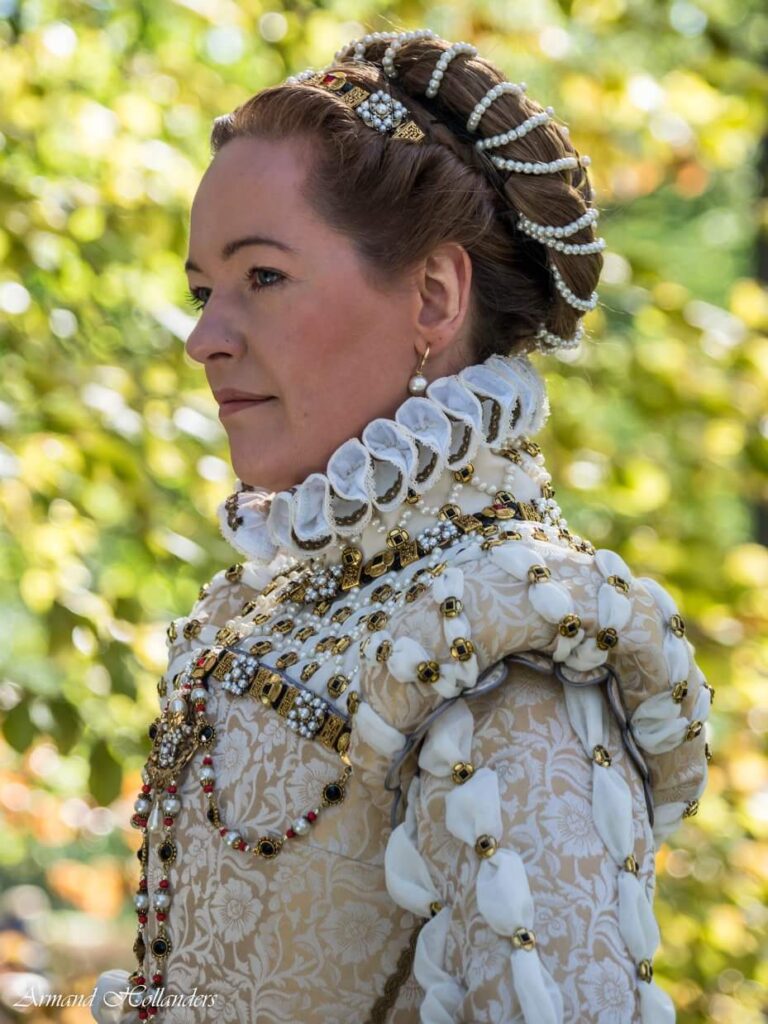
Angela, with her expertise in product development and pattern cutting, crafts astonishingly detailed reproductions of historical garments that the two of them wear in various re-enactment events. Angela and Jasper also build sets and scenes, organize medieval banquets, give presentations about the costumes, and portray historical figures at events and in television series.
Personally, I’ve been following Walking Through History on social media for a couple of years, always impressed by Angela’s skills in recreating historical costumes. And naturally, I had some questions about her process.
Q: How did you first become interested in historical garments? What was your very first project?
A: We have always visited Fantasy Events, and about 16 years ago, we decided to dress up with a group of friends as a couple of characters from Alice in Wonderland. We had so much fun that the year after, we decided to dress up again, but this time as characters from The Tudors.
These were our first historical costumes. From that moment on, I decided to focus only on historical costume recreation. After this, I started to read more about Fashion History (although I already learned about it in school) to improve my work. Finally, about 10 years ago, I decided to get an official degree in Costume History.

Q: Are there particular eras or styles you’re most drawn to?
A: Yes, definitely, 16th and 17th century, and I usually make upper-class/noble clothing in Western European style. About 75% of our costumes fall in this range. But I also love late medieval, 19th century (Napoleonic and late Victorian), and the first half of the 20th century.
Q: How do you research historical garments and construction techniques? For example, paintings: How do you pick the materials and construct the parts of the clothes that are not visible in the painting?
A: In regard to the materials, I read about which fabrics were commonly used in the period. My starting point is usually paintings, but I try to find other images like drawings, full-size paintings, etc, to see the entire garment.
Luckily, in the 17th century, people were also often painted from the back, side, full length, etc. And most painters made studies/sketches that are very useful.

Q: Do you try to recreate garments as authentically as possible, or do you sometimes adapt historical styles for modern wear?
A: I only create historical costumes for events, historical occasions, etc., not for daily wear. So I don’t have any history-bound clothing. However, in my daily life, I wear 1930s/1940s-style clothes, but they don’t need to be adapted for modern wear.
Q: What are the biggest differences between sewing modern clothes and sewing historical garments?
A: The biggest difference is how the pattern is drafted. That is why I always suggest that people use period patterns.
The second difference is that the construction of the bodices is totally different because of the canvas interior of the garment. This is not constructed by putting two layers of fabric with the right sides together under the sewing machine, but the outer shell is wrapped around the interior (foundation) and secured on the inside by hand. The parts are then later sewn together (by hand).
Q: Do you use traditional materials and methods when making historical garments? Do you ever use the sewing machine?
A: I use the sewing machine for boning channels in the foundation, and for interior seams of garments that don’t have a foundation inside (sleeves, skirt, etc.). All the rest is done by hand.
Q: Are there any historical techniques or hand-sewing methods you particularly enjoy?
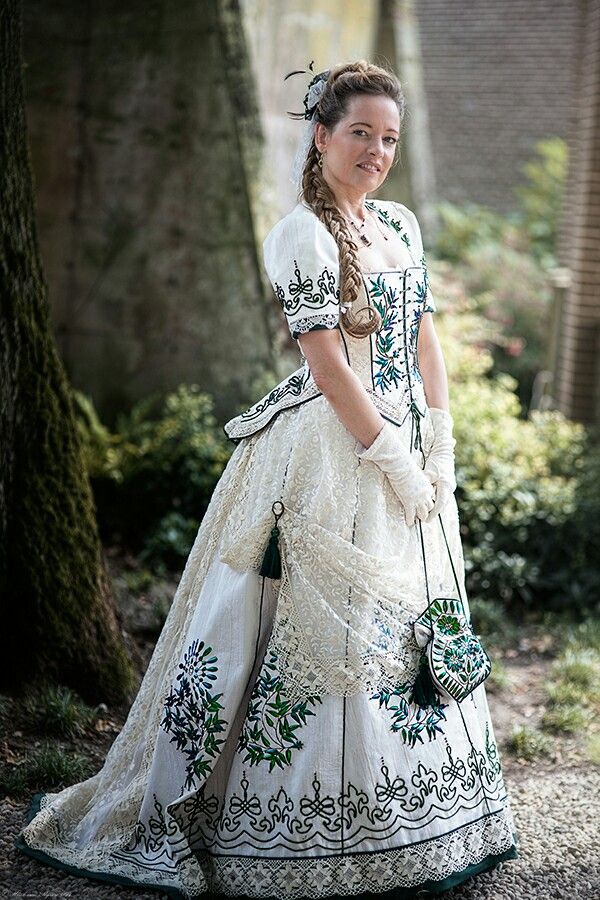
A: I love to embroider, and I also love to work with beads and metal parts. I also find sewing in a lining by hand very satisfying. And I also love to embroider eyelets. Also, I often decorate the garment with braiding, and this is also very satisfying.
Q: How do you source fabrics and other materials that are historically accurate or close to the originals?
A: I don’t use a large variety of fabrics; most are made of silk or wool, and sometimes linen.
I have a couple of addresses where I can purchase silk. The jacquard weave or embroidered silk is from India (I use Etsy to find these). Wool comes from Germany, and linen I can buy here in the Netherlands.
I also like to use very sheer antique linen for collars and cuffs, and I get those from antique church smocks, or from antique markets/undergarments.
Q: Do you make the headpieces, hats, ruffs, and other accessories yourself? How did you learn?
A: Yes, I make everything myself. I learned how to make ruffs through online tutorials, but I believe it’s also described by Janet Arnold and The Tudor Tailor.
For hats, I work with buckram and millinery wire. I learned this via step-by-step instructions that come with the patterns.
Q: How do you approach patternmaking for historical clothes? It must be quite different from how modern patterns are drafted.
A: It’s entirely different. I studied pattern making for three years in Belgium, but modern patterns don’t look like historical patterns at all.
So I get my patterns from books. The patterns are authentic, and all I do is enlarge them and adjust the width and height to my own body. After this, I make a muslin and make more small adjustments to the pattern where needed, without losing the original shape.


Q: How long does it generally take you to make a garment from start to finish?
A: Normally around three months, excluding research. The first month is all about pattern drafting, muslins, etc. Usually, the second month is for constructing, and then month 3 for decorating. I try to dedicate about 15-20 hours per week to working on the costumes.
Q: What’s your favorite project you’ve worked on so far? How about the most difficult?
A: My favorites are the beetle wing embroidered Victorian bustle gown and the white silk dress from Elizabeth of Austria, both because of the decorations I made on them. That is the most fun for me to do.
I don’t think there is a particular costume that was more difficult than others.
_-_Google_Art_Project.jpg)
Q: What are you currently working on or planning to make next?
A: Currently, I have to do some repairs because of an event we had last weekend 🙂 .
Next week I am going to start with writing a new presentation on how to make historical corsets. The presentation is in August, but I need a lot of time to make a new presentation, and for this, I also have to make examples in fabric of all the steps, so people can clearly see step by step how to make a corset for themselves.
After this is ready, I have planned two new dresses based on a very lovely image by Adriaen van de Venne, circa 1620.
Q: What advice would you give to someone who wants to start making historical garments?
A: First, find an image of the outfit you really like. Then try to find the pattern that matches it. Make some trials first in cheap fabric before you start cutting up your lovely expensive fabrics. Don’t use synthetic fabric or trims. And keep the closures authentic, so no zippers etc. Success guaranteed.
Q: Are there any good resources (books, museums, online archives, or websites) you recommend for learning about historical clothing and techniques?
A: Yes, luckily, there are many, and you can’t do without them. The resources I use the most are the six books by Janet Arnold, and the five books by the Tudor Tailor, then the three books from Norah Waugh, and the three books from the V&A Museum.
Links to find out more and follow Walking Through History
You should definitely check out these to see more pictures of all the costumes Angela has made.
